Meet 01959.HK: The first yield-generating stock, unlocking a new era of liquidity
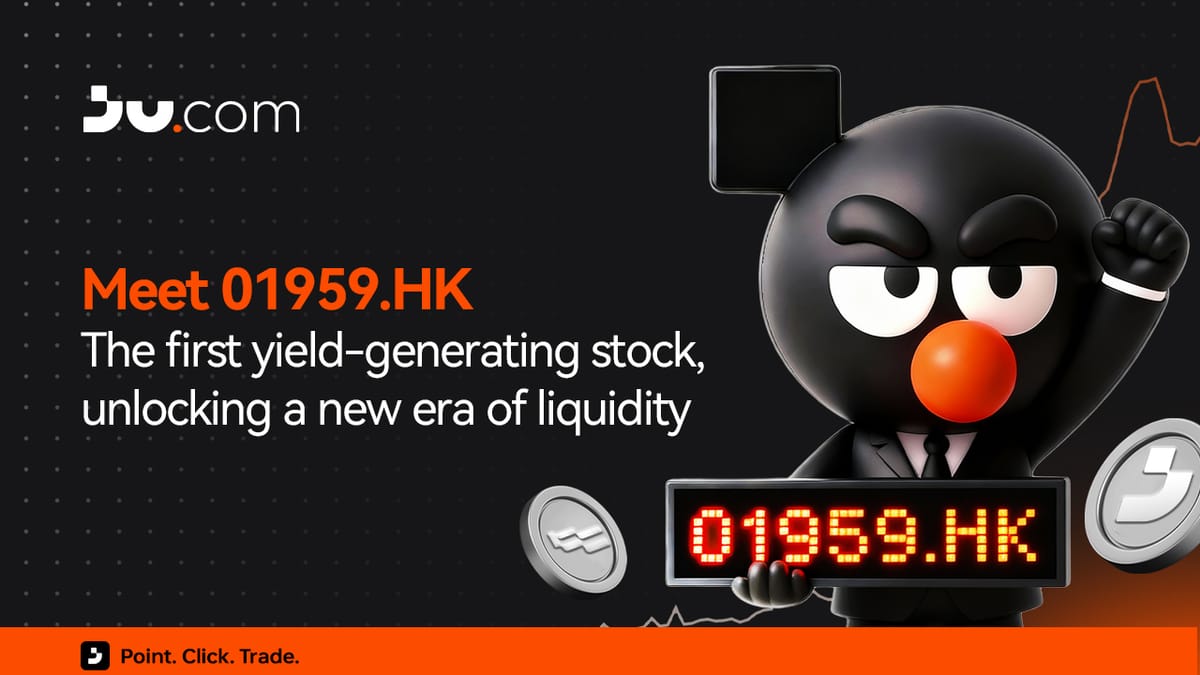
On December 1, 2025, the Hong Kong stock market witnessed a critical breakthrough. The listing of Century United Holdings (01959.HK) on Ju.com became the first stock to complete a full cycle through real-stock custody combined with on-chain staking. This mechanism is called PoSL (Proof of Stock Liquidity), which enables real stocks custodied by licensed brokers to generate mining rewards on the blockchain while investors retain full shareholder rights. From this moment onward, stock value creation gained a new dimension. Beyond waiting for price fluctuations, shares themselves can now be locked, mined, and continually generate liquidity rewards like DeFi assets.
The core narrative behind this innovation is simple yet powerful: stocks can have liquidity too. When holders of 01959 stake their shares on the xBrokers platform, they retain full shareholder rights, including dividend entitlements, while unlocking an entirely new income layer. The traditional return formula of stock investing expands into a triple-yield model of “price appreciation + dividend income + staking rewards.” In this model, stocks no longer rely solely on price movement—holding itself continuously produces liquidity. As a model asset, 01959 is validating the viability of this path and laying the foundation for more stocks to follow.
From Dormant to Activated: The Second Life of Stock Assets
In the traditional financial system, stocks typically sit idle in broker accounts after purchase, creating value only through price movements or occasional dividends—a model that has persisted for over a century. The collaboration between Ju.com and xBrokers introduces Web3-style liquidity mining into the conventional securities market, enabling stocks to generate continuous income.
The PoSL mechanism operates in a relatively straightforward way. After investors stake their 01959 shares on the xBrokers platform, the system generates on-chain liquidity certificates representing ownership of real stocks held in custodial accounts while also producing mining power. The more shares staked and the longer the duration, the higher the mining power, resulting in greater X token rewards.
Staking preserves all traditional shareholder rights. Holders of staked 01959 shares still enjoy full dividend rights, can participate in shareholder meetings, and exercise voting rights. Annual reports and corporate disclosures are delivered as usual. Blockchain technology adds an income layer atop the existing securities system—investors become both traditional shareholders and liquidity providers in the Web3 ecosystem.
From a macro perspective, the listing of 01959 validates a potential integration pathway between TradFi and DeFi. The bridge built by Ju.com and xBrokers enables real stocks custodied by licensed brokers to generate on-chain returns, giving traditional assets DeFi-like efficiency and yield generation while maintaining TradFi’s safety and regulatory compliance. Shares that once lay dormant in accounts now gain the ability to continuously output liquidity.
xBrokers: The Technical Architecture of Real-Stock Custody and On-Chain Certificates
The xBrokers platform adopts a dual-track structure of “real-stock custody + on-chain certificates.” Many stock tokenization projects only mirror stock prices on-chain; the tokens merely track price movement and do not provide real shareholder rights. xBrokers partners with licensed brokers worldwide to ensure that each on-chain certificate is backed by real shares in custodial accounts—investors hold actual equity.
The core of the architecture is the 30% dynamic reserve mechanism. Traditional DeFi staking often requires 100% lock-up—safe but capital-inefficient. xBrokers uses a risk management model to keep reserves at around 30%, allowing the remaining 70% of funds to stay liquid, maximizing capital efficiency. This ratio is based on extensive market data analysis and stress testing to ensure safety even under extreme volatility.
Security protection exists at three levels. At the compliance custody layer, all underlying securities are held by licensed brokers in accordance with Hong Kong SFC requirements, with client assets segregated from broker assets. At the on-chain transparency layer, every staking, redemption, and reward distribution event is recorded on JuChain in real time and viewable through the blockchain explorer. At the smart risk-control layer, the system dynamically adjusts risk parameters based on market volatility, liquidity depth, and staking ratios to protect user assets while maintaining system flexibility.
From a user experience standpoint, once investors complete a single KYC, they can purchase 01959 using fiat or stablecoins and then enable staking with one click. JuChain’s one-second block time and extremely low gas fees make the staking experience similar to using a traditional brokerage app.
For users, it’s just one extra click to stake; for the underlying infrastructure, it signifies the first time licensed custody, on-chain mining power, and an RWA yield network are merged into one system.
Holder as Builder: The Positive Flywheel of the Staking Economy
xBrokers emphasizes the core philosophy of “holders are builders.” In traditional stock markets, small shareholders are usually passive price-takers with minimal influence on company development or ecosystem building beyond buying and selling. In the xBrokers system, every investor who stakes 01959 contributes liquidity, increases activity, and enhances asset visibility through their actions.
The mining power earned from staking represents the investor’s contribution to the ecosystem. The larger and longer the stake, the more stable the liquidity provided to the market and the stronger the support for price discovery. The system quantifies this contribution through mining power and rewards it in the form of X tokens. Rewards come from the platform’s real revenue, including trading fees, service fees, and data usage fees. These revenues are periodically used to repurchase tokens or inject them into the reward pool, forming a sustainable value cycle.
The mechanism design avoids a “whale effect.” xBrokers uses tiered incentives and upper limits to ensure that small investors also receive fair returns. A retail holder staking 1,000 shares of 01959 may earn a higher relative reward rate than large holders due to additional incentive coefficients for long-term small staking. This design encourages broad participation and promotes sustainable ecosystem growth.
The referral and VIP programs strengthen the positive flywheel. Investors can earn rewards through staking, referring new users, engaging in the community, or providing liquidity. Strict performance metrics and tiered caps ensure that rewards correlate directly with actual contribution, maintaining ecosystem health.
X Token: A Value Bridge Between Traditional Finance and Web3
The X token is the core value carrier of the xBrokers ecosystem. Its design follows three core principles to ensure it can fulfill its mission of bridging the two financial worlds.
The first principle is real revenue return. The X token’s value is anchored to the actual business performance of the xBrokers platform. Revenue generated from stock trading, staking services, and data subscriptions is regularly used for X token buybacks, reward-pool injections, or fee reductions. As the platform grows, the intrinsic value of X increases accordingly. Holding X essentially allows investors to share in xBrokers’ growth.
The second principle is governance empowerment. X token holders participate in major decision-making processes, from selecting new stock listings to adjusting fee rates, determining technology roadmaps, and approving ecosystem partnerships. Governance ensures that the platform develops toward maximizing community benefit.
The third principle is diverse use cases. The X token is integrated throughout the xBrokers ecosystem. Holding X grants trading-fee discounts; staking X unlocks higher VIP benefits; using X for new-stock subscriptions provides preferential pricing. Future applications may include cross-chain bridging, NFT minting, and derivatives trading. Each new use case enhances the token’s utility and drives demand.
The token-distribution strategy prioritizes the community. All X tokens are allocated through mining-power emissions, enabling fair participation for everyday investors.
Ju.com Ecosystem Synergy: The Multiplier Effect of Platform Integration
The listing of 01959 on xBrokers is supported by the broader Ju.com ecosystem. Ju.com is a complete Web3 financial infrastructure platform with over 50 million registered users across 100+ countries and $5 billion in daily trading volume. This user base and traffic provide a unique advantage for RWA projects.
Ecosystem synergy creates value across multiple dimensions. With integrated trading access, Ju.com combines stock purchase, staking, and token trading in one platform. From buying 01959 to trading JU and X tokens earned through staking, everything happens within a single interface, reducing friction caused by switching platforms.
Integration with the payment ecosystem delivers real-world utility. With JuCard and JuPay, rewards earned from staking 01959 can be directly converted into everyday spending power. JuCard users can spend at millions of merchants across 200+ countries, using staking rewards to pay for dining, shopping, travel, and more—completing the loop of “holding → staking → spending.” Liquidity extends beyond secondary-market trading and enters daily life.
The 100-Stock Plan: From Prototype to Scalable Adoption
01959 is only the first step. After its successful full-cycle validation, Ju.com’s goal is to replicate the same mechanism across more than 100 Hong Kong stocks, followed by expansion into U.S. equities and other asset classes.
The first phase focuses on Hong Kong. As an international financial center, Hong Kong has a mature regulatory framework and well-developed securities infrastructure. The SFC takes a relatively open stance toward blockchain applications in finance, and several virtual asset trading platforms already operate with licenses. xBrokers chose Hong Kong not only for regulatory openness but also because the market contains many fundamentally strong yet low-liquidity mid-cap stocks—ideal candidates for liquidity-enhancing staking mechanisms.
The 100 upcoming stocks will span technology, blue chips, consumer healthcare, finance, and property sectors. Selection criteria include: regulatory compliance (operating properly under SFC oversight), market liquidity (allowing fundamentally strong but thinly traded stocks to receive new liquidity), and issuer collaboration (companies willing to explore on-chain stock models with xBrokers).
The second phase targets U.S. equities—the world’s largest and most mature stock market. Major tech companies like Apple, Microsoft, and Tesla, along with S&P 500 constituents, will gradually become stakeable. This expansion increases the total number of stakeable stocks to over 200 and covers trillions of dollars in market capitalization, transitioning xBrokers from a regional platform to global infrastructure.
The third phase extends to bonds, ETFs, and private placements. U.S. Treasuries, corporate bonds, and high-yield bonds will support staking. Stock ETFs, bond ETFs, and commodity ETFs can be staked for dual yields. Private-placement innovation—enabled through a “blind-box” subscription model—allows retail investors to participate in high-quality IPO allocation opportunities typically reserved for institutions.
Throughout the expansion, xBrokers maintains close communication with regulators. Every new market begins with obtaining necessary licenses and forming partnerships with licensed local brokers to ensure full legal compliance. This cautious approach prioritizes long-term sustainability and reduces regulatory risk.
Beyond Stocks: New Possibilities for Asset Ownership
The staking of 01959 demonstrates a new way to imagine asset ownership. In traditional finance, ownership and income rights are usually bound together—you either hold the asset or sell it. Blockchain makes more flexible options possible.
A future investment portfolio may look like this: an investor holds 10 Hong Kong stocks, 5 U.S. stocks, and 3 bond ETFs—all staked and generating mining rewards. When liquidity is needed, they don’t need to sell anything; instead, they can use the staking certificates as collateral to borrow stablecoins through an RWA lending protocol. Those stablecoins can be used for new investments, daily spending, or participation in other DeFi protocols, all while retaining ownership of their underlying assets.
Risk management also becomes more flexible. Traditional portfolio adjustments require frequent trades, each incurring fees and slippage. In the xBrokers system, investors can optimize risk-return by adjusting staking ratios without executing actual trades. Increasing a stock’s staking share increases mining power; reducing it lowers exposure—achieved entirely on-chain at minimal cost.
For institutional investors—pension funds, insurers, and other long-term capital—this model is particularly valuable. These institutions already hold large portfolios of long-term equities, most of which remain idle. Staking provides an additional income layer without altering investment strategy. This liquidity-provision income aligns with ESG principles and holds social value. As regulatory frameworks mature, more institutional capital may adopt this method to participate in Web3 ecosystems.
Toward the Tokenized RWA Market
The staking of 01959 marks an important milestone in the development of tokenized RWAs. According to market data, the current RWA tokenization market is about $35 billion, dominated by U.S. Treasuries and cash-like instruments, with stock tokenization still in its early stages. The global stock market exceeds $100 trillion in value; if even 1% of equities become tokenized and stakeable, it would represent a trillion-dollar market.
The potential comes from newly created value. Traditional stock markets suffer from multiple pain points: mid-cap stocks with low liquidity struggle to attract institutional investors; cross-border investing faces FX and tax barriers; long settlement cycles reduce capital efficiency; and high minimum investment thresholds exclude retail investors. Tokenizing stocks and enabling staking can address all these issues—injecting liquidity into mid-cap stocks, making cross-border investing as simple as a DEX swap, enabling instant settlement, and fractionalizing shares for retail participation.
Ju.com aims to reach 100 million users and $10 billion in daily trading volume by 2026. For context, global stock markets trade over $500 billion daily; $10 billion is 2% of that. Major crypto exchanges trade $10–30 billion daily. If Ju.com makes stock staking a mainstream action, achieving this scale is feasible. The key lies in whether product experience, regulatory compliance, and ecosystem integration produce real value.
Competition is evolving. Robinhood already offers 24/7 tokenized stock trading in the EU, and other major platforms are exploring RWAs. xBrokers differentiates itself through the staking mechanism—others make stock trading convenient, xBrokers enables stocks themselves to generate extra value. As the 100-stock plan advances, xBrokers will gain a wide selection of stakeable stocks, forming network effects and early-mover advantages.
The Future of Stock Liquidity
Throughout financial history, each major technological breakthrough has transformed capital flow. Double-entry bookkeeping in the 15th century made trade transparent; joint-stock companies in the 17th century enabled large-scale financing; electronic trading in the 20th century connected global markets in real time. Stock tokenization and staking add a new dimension of value—ownership certificates that can continuously produce liquidity.
This model carries multifaceted impact. For investors, it provides new asset allocation tools and yield-enhancement strategies. For listed companies, staking can improve liquidity and attractiveness, potentially lowering financing costs. For financial markets, it connects trillions in traditional securities with the DeFi ecosystem, increasing capital efficiency. For Web3, RWAs are a key step toward mainstream adoption, and stocks are among the most intuitive and accessible types of RWAs.
As one of the first stakeable Hong Kong stocks, 01959 verifies this pathway. It proves that the dual-track model of real-stock custody and on-chain certificates can operate in practice, that innovation is possible within current regulatory frameworks, and that investors genuinely demand this model. The next 100 or 1,000 stocks will expand the ecosystem and gradually reshape how financial markets function.
Stocks can have liquidity. Starting with 01959, and through the collaboration between Ju.com and xBrokers, stocks are evolving from assets dependent solely on price fluctuation into assets capable of producing continuous yield. The fusion of TradFi and DeFi is forming, and the definition of asset ownership is expanding. Participants in this process are both observers and builders.